Richard and Cathy Weise’s Glendale Eye Medical Group will join the USC Roski Eye Institute, expanding patient care opportunities in Southern California.
Category: Uncategorized
How to live a longer, happier and healthier life
There are specific steps you can take. Take it from our USC experts as they share their research insights.
USC researchers turn the body’s B cells into tiny surveillance machines, antibody factories
The B cell research is an important advance in treating conditions ranging from Alzheimer’s to arthritis. (Illustration/iStock)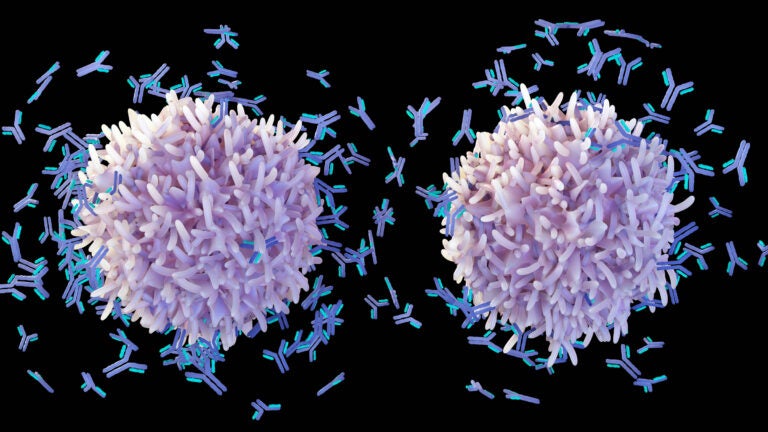
Health
USC researchers turn the body’s B cells into tiny surveillance machines, antibody factories
The technology could be used to treat or prevent chronic diseases or infections such as HIV.
USC scientists have discovered a way to turn the body’s B cells into tiny surveillance machines and antibody factories that can pump out specially designed antibodies to destroy cancer cells or HIV, two of medicine’s most formidable foes.
The research, published Monday in Nature Biomedical Engineering, describes a technique for editing the genes of immune cells called B cells, turbocharging them to fight even the sneakiest invaders. The work is an important advance in harnessing the power of antibodies to treat conditions ranging from Alzheimer’s disease to arthritis.
“In some diseases or conditions, the natural antibodies made by B cells are just not good enough,” said senior author Paula Cannon, a Distinguished Professor of Molecular Microbiology & Immunology at the Keck School of Medicine of USC. “HIV is a very good example of that. It mutates constantly, keeping one step ahead of whichever antibodies are being thrown at it. We thought a checkmate move might be persuading B cells to make an antibody that was so broad in its ability to ‘see’ HIV that HIV couldn’t easily mutate around it.”
The beauty of the technique, the researchers said, is it can be adapted to produce a broad range of different antibodies.
“It’s a technology for reprogramming B cells that could be applied to almost anything you can imagine dealing with an antibody,” said first author Geoffrey Rogers, a research associate and senior postdoctoral fellow in Cannon’s lab. “We think we’ll be able to completely customize everything about the antibody.”
For this project, the researchers took inspiration from chimeric antigen receptor (CAR) T cells, “living drugs” designed to target specific things. They’ve revolutionized treatment for blood cancers like leukemia and lymphoma. With CAR T treatment, T cells — sister cells to B cells — are removed from a patient’s blood and genetically modified to identify cancer cells by recognizing a marker on their surface. Millions of the cells are then infused into the patient’s body, where they fight disease and then fade away.
How B cells behave
B cells behave differently, making them more suitable for fighting chronic conditions. They function as both a security system and antibody factory, residing long-term in the bone marrow, lymph nodes and spleen — and firing up when needed.
To make these tiny fighters, Cannon and Rogers used CRISPR gene editing methods to place the instructions for custom antibodies at the exact site in the B cell’s DNA where antibodies are naturally made. This trick means that B cells can be reprogrammed as biofactories making the custom antibodies. And just as regular antibodies respond to vaccination, the reprogrammed B cells could also be stimulated to increase their output.
Researchers were able to observe the antibodies at work using tonsil tissue to replicate an immune system in a dish.
The researchers are working with the USC Stevens Center for Innovation to license the technology for commercial use. The USC Stevens Center helps scientists shepherd their discoveries from the lab to the market.
“We’re really excited to help try and bring this to biotech companies,” said Erin Overstreet, executive director of the USC Stevens Center. “This could be a fundamental shift in how we approach certain diseases.”
In addition to Cannon and Rogers, other authors of the paper are Chun Huang, Atishay Mathur, Xiaoli Huang, Hsu-Yu Chen, Kalya Stanten, Heidy Morales, Chan-Hua Chang and Eric Kezirian, all of USC.
The work was supported with grants from the National Institutes of Health (HL156274, AI164561, AI164556 and MH130178).
New USC pharmacy opens on University Park Campus
The pharmacy in King Hall, near the Engemann Student Health Center, more than doubles the space of the previous location, and increases services as well.
Mental health disparities in L.A. County worsened during COVID pandemic, study shows
Depression risk grew more common among non-white residents, with the largest effects in areas hit hardest by pandemic deaths.
How USC engineers are using ultrasound to restore vision
A USC Viterbi research team is using non-invasive technologies to target degenerative visual impairments.
Witnessing violence harms brains of older teens, but ‘transcendent thinking’ may be an antidote
Teens who think about social issues and violence in reflective ways show greater resilience to the effects of violence exposure on their brain development, USC research finds.
New ‘smart bandages’ hold potential for revolutionizing treatment of chronic wounds
USC researchers are co-leading an effort to develop advanced electronic bandages and other tools to improve chronic wound monitoring and healing.
Cirrhosis affects twice as many transgender adults as cisgender adults
The study from Keck Medicine of USC suggests a need for more supportive, preventive care.
USC Family Caregiver Support Center launches innovative caregiving educational program
CalGrows grant-funded project focuses on the needs of care workers serving adults with Alzheimer’s disease.