Study incorporates diversity, equity and inclusion into a clinical trial for age-related macular degeneration, aiming to restore vision and rebuild trust in marginalized communities.
Category: Uncategorized
Dispelling the misleading myth of the ‘model minority’
Data uncovers hidden needs that defy the common perception of all Asian Americans as well-educated, healthy, self-sufficient and problem-free.
Molecules derived from sea sponge show promising effects in cancer, mitochondrial function
Mycothiazole and its synthetic derivative target the mitochondria’s electron transport chain and show targeted toxicity against human cancer cells as well as anti-aging properties in worms.
How one Trojan’s master’s degree laid the groundwork for a career in global public health and research
For Alexander Woodman, a Master of Science in Gerontology degree was an important step in becoming a leading health researcher in the Middle East.
USC medical school dean appointed to California Institute of Regenerative Medicine board
Carolyn Meltzer takes on a governance role with the state stem cell agency.
Brain study identifies a cost of caregiving for new fathers
Becoming a dad affects the brain — even without the direct experience of pregnancy, a study of male brain changes across the transition to first-time parenthood finds.
Don’t fear that needle: Research paves way for flexible ‘soft’ microneedles
Hangbo Zhao presents findings on highly stretchable and customizable microneedles for application in fields including neuroscience, tissue engineering, and wearable bioelectronics
Researcher awarded $3M to study early brain development of babies born to mothers with diabetes
The study will investigate neural biological mechanisms underlying the link between diabetes in pregnancy and child’s risk of obesity.
Keck Medicine of USC and USC’s health sciences schools make sustainability a priority
USC’s health sciences schools and Keck Medicine of USC aim to heal the planet. (Photo/iStock)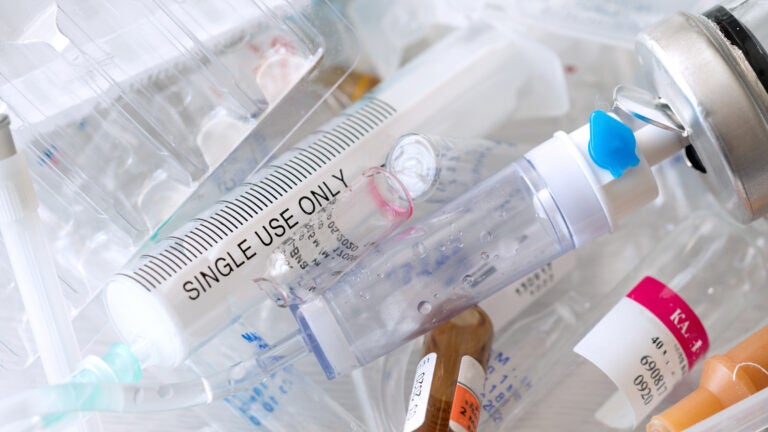
Health
Keck Medicine of USC and USC’s health sciences schools make sustainability a priority
By upcycling ocean plastics, reducing harmful anesthesia gases and transforming medical supply chains, the USC health system and medical research schools hope to curb pollution.
Anyone who has spent time in a hospital or doctor’s office can see the enormous amount of waste generated in patient care. But at Keck Medicine of USC and within USC’s health sciences schools, there’s a robust movement to shrink health care’s carbon footprint.

As part of USC President Carol Folt’s sustainability “moonshot,” USC’s Office of Health Affairs organized a recent panel discussion on the issue of medical waste. The office, led by Senior Vice President for Health Affairs Steve Shapiro, encompasses USC’s health system and the university’s five health sciences schools: the Keck School of Medicine of USC, the USC Leonard Davis School of Gerontology, the USC Mann School of Pharmacy and Pharmaceutical Sciences, the USC Suzanne Dworak-Peck School of Social Work and the Herman Ostrow School of Dentistry of USC, which includes the USC Mrs. T.H. Chan Division of Occupational Science and Occupational Therapy and the USC Division of Biokinesiology and Physical Therapy.
“Keck Medicine and the health sciences schools stand at the forefront of climate action, driving change within our hospital, our schools, across our campuses and within our local communities,” said Michele Kipke, associate vice president for strategic health alliances, who helped organize the panel. “Through innovation, we’re paving the way toward a more sustainable future.”
Anesthesiologist Arash Motamed, medical director of sustainability with Keck Medicine, detailed plans to continue reducing the use of environmentally harmful anesthesia gases in surgery. Last year, Keck Hospital of USC and USC Norris Cancer Hospital eliminated nitrous oxide and desflurane. Next up is cutting the use of two more anesthetics — sevoflurane and isoflurane — by 75%.
The annual reduction in emissions would represent the equivalent of driving around Earth’s circumference more than six times, Motamed said.
Sustainability in medicine: Working with industry partners
Motamed also discussed negotiations with industry partners to customize medical supply kits and offer reusable supplies. Many medical supplies come in packs that include items that are unnecessary and go straight to landfills. Reusable laryngoscopes, a tool used to check a patient’s airway, will be rolled out soon.
Other panelists described a wide array of sustainable initiatives:
- Clay Wang of USC Mann presented his work upcycling plastic bags and bottles plucked from the ocean by composting them with a special fungi — transforming trash into pharmacologically active compounds.
- Camille Dieterle of USC Chan discussed her work in environmentally informed occupational therapy. This approach is based on research linking personal and public health with ecological conditions.
- Sarah Hamm-Alvarez, a professor of ophthalmology and pharmacology and pharmaceutical sciences, spoke of recycling nitrile gloves as flooring materials. Such a project could remove from landfills tons of these gloves, which take hundreds of years to break down.
For environmental health researcher Max Aung, the panel was a chance to meet new colleagues and kick off potential collaborations. Aung and fellow researcher Lida Chatzi won a USC President’s Sustainability Initiative Award for their project assessing community exposures to “forever chemicals” or PFAS (short for perfluoroalkyl and polyfluoroalkyl substances) via drinking water in Southern California.
“I didn’t realize how much exciting sustainability stuff is going on across USC,” Aung said after the panel. “I think there’s a lot of potential for collaboration, for workshopping ideas together.”
USC Price grad clowns around to help hospital patients
Phong Doozy volunteers as a medical clown to put smiles on the faces of those facing serious health challenges.