The Researchers Making Drug Development Safer

USC researchers are using machine learning to uncover insights that could lead to safer and more effective drug development. (Photo/iStock)

USC researchers are using machine learning to uncover insights that could lead to safer and more effective drug development. (Photo/iStock)

Health

The Researchers Making Drug Development Safer

Professors Gauri Rao and Prashant Dogra are using AI to accelerate drug development at USC Mann.

July 20, 2026

By Chinyere Cindy Amobi

Across USC’s schools and campuses, researchers, faculty and practitioners are developing innovative solutions for societal issues, imagining new approaches to making art and finding ways for creators to prepare for a shifting landscape as AI increasingly intersects with different fields.

Under USC President Beong-Soo Kim’s leadership, advancing ethical AI that puts people first has become a university priority — building on USC’s legacy of innovation while preparing the next generation of researchers, scientists, engineers, entrepreneurs, artists and health professionals. 

This story is part of Trojan Family Magazine’s AI series highlighting the people and ideas driving USC’s vision forward. 

AI is helping USC researchers answer a question with life-or-death consequences: Why do medications work well for some patients but not others?

Gauri Rao, associate professor of clinical pharmacy at the USC Alfred E. Mann School of Pharmacy and Pharmaceutical Sciences, is the director of the Center for Quantitative Drug and Disease Modeling. At her lab, Rao and her team are using machine learning to find the answer, analyzing vast amounts of bacterial genomic and metabolomic data to better understand the mechanisms that drive antimicrobial resistance.

By identifying patterns in bacterial genomes and metabolic pathways, the team aims to predict how bacteria develop resistance to antibiotics and uncover strategies to preserve the effectiveness of existing therapies. Their work combines advanced computational approaches with experimental research to address one of the world’s most pressing public health challenges.

“Developing a new antibiotic is incredibly costly and can take more than a decade,” Rao says. “Given the urgent rise in antimicrobial resistance, we are focused on using machine learning and quantitative modeling to maximize the effectiveness of the antibiotics we already have and help slow the emergence of resistance.”

Given the growing threat of drug-resistant infections, a large portion of Rao’s research program is dedicated to bacteriophage (phage) therapy, an emerging approach that uses naturally occurring viruses to target and kill bacteria. Rao says machine learning is critical for helping researchers rapidly identify phages that are most likely to be effective against specific bacterial pathogens.

Developing a new antibiotic is incredibly costly and can take more than a decade. Given the urgent rise in antimicrobial resistance, we are focused on using machine learning and quantitative modeling to maximize the effectiveness of the antibiotics we already have and help slow the emergence of resistance.


Gauri Rao, director of the Center for Quantitative Drug and Disease Modeling

Rao is part of the National Institutes of Health’s first coordinated U.S. research network for phage therapeutics. Through this collaborative effort, computational approaches, including machine learning, are integrated with laboratory (in vitro) and animal model (in vivo) testing to identify promising phage candidates and accelerate their translation into clinical practice. The goal is to develop more precise and effective treatments for multidrug-resistant infections while preserving the effectiveness of current antibiotics.

Prashant Dogra, associate director of the center and assistant professor of clinical pharmacy at USC Mann, also integrates mechanistic mathematical modeling with AI to better understand disease mechanisms and drug delivery systems.

One of Dogra’s current projects, supported by funding from the NIH, studies how nanomedicines move through the body to design safer and more effective drug delivery systems to transform treatment for diseases ranging from cancer to chronic illnesses.

Using machine learning, he analyzes a large body of published studies to identify design principles for safer and more effective nanoparticles, potentially leading to better clinical outcomes for patients.

Dogra, who joined the USC Mann faculty last year, says he can’t imagine doing the projects he’s currently working on at any other university.

“I think USC has a very interdisciplinary environment that I find is really unmatchable,” Dogra says. “Having access to colleagues who are very strong in complementary domains facilitates newer ways of thinking and allows us to develop these novel methods of pursuing our scientific questions.”


Read the entire series: USC at the Leading Edge of AI

Part 1: The Business Students | Part 2: The Pharmaceutical Developers | Part 3: The Creatives | Part 4: The Filmmaker | Part 5: The Urban Planners

Dementia risk factors look different around the world, large USC study finds

Illustration: Genetic changes

The study set out to see if patterns observed in wealthy countries such as the United States were also found in low- and middle-income countries. (Photo/iStock)

Health

Evolutionary history may help explain why some people develop more severe COVID-19 than others

Because risk factors such as low education, high blood pressure and smoking vary widely, a one-size-fits-all approach to prevention won’t work.

August 04, 2026

By Leigh Hopper

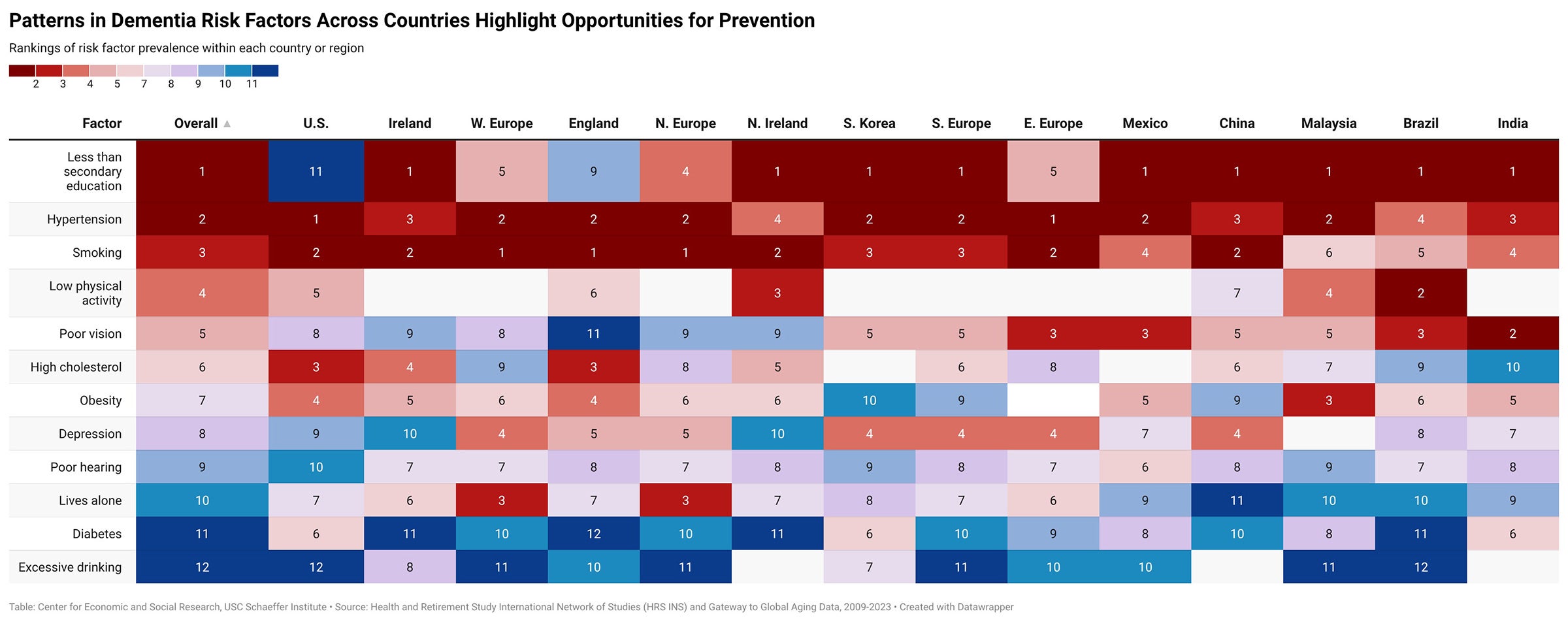
A major, USC-led study of more than 214,000 older adults across 14 countries and regions finds that the most common controllable risk factors for dementia — such as low education, high blood pressure and smoking — vary widely from country to country, meaning a one-size-fits-all approach to prevention won’t work everywhere.

The findings appeared Sunday in the journal The Lancet Healthy Longevity.

Most of what scientists know about preventing dementia comes from research in wealthy countries such as the United States and those in Western Europe. But this study, led by researchers at USC along with colleagues at Brown University and Johns Hopkins University, set out to see whether those same patterns hold true in low- and middle-income countries.

Differences — and similarities — in dementia risk factors

The differences were striking — but so were the similarities:

  • Differences: Low education affected 86% of older adults in China but only 12% in the United States, while high BMI (a measure of excess body weight) affected 45% of Americans compared to just 13% of people in India.
  • Similarities: Certain risk factors tended to cluster together in similar patterns worldwide, such as cardiovascular risks (for example, high cholesterol and hypertension) or risky behaviors (such as smoking and drinking).

Lead author Emma Nichols, a research scientist with the Center for Economic and Social Research at the USC Schaeffer Institute for Public Policy & Government Service, says the consistency of these clusters was the most unexpected part of the findings.

“I was less surprised by the differences and more surprised by some of the similarities, particularly in the ways these risks are patterned across settings,” Nichols said. “That has real implications for how we design prevention strategies and interventions, because some things are more consistent across places than we might expect.”

Graphic: Potential dementia risk factors
View an enlarged version of the graphic depicting differences and similarities in dementia risk across different countries. (Graphic/USC Schaeffer Center for Economic and Social Research)

For the study, researchers from the Gateway to Global Aging Data team combined harmonized survey data from long-running aging studies in 14 places — the United States, Brazil, China, England, India, Ireland, Korea, Malaysia, Mexico, Northern Ireland and four regions of Europe — collected between 2009 and 2023. (Jinkook Lee of the Center for Economic and Social Research at the USC Schaeffer Institute is principal investigator of the Gateway to Global Aging Data project as well as the Longitudinal Aging Study in India.)

They analyzed 12 modifiable risk factors identified by the Lancet Commission on dementia — things such as hearing loss, depression, physical inactivity and social isolation, comparing how common each factor was; how they varied by age, gender and education level; and how often multiple risk factors showed up together in the same person.

Dementia risk factors help guide decision-making

The researchers say the findings should help guide decision-makers and health organizations in designing dementia-prevention strategies tailored to their own populations. For example, a program that connects people to care for diabetes could be redesigned to address the entire cluster of related cardiometabolic risks, such as high cholesterol and hypertension, at the same time.

For the average person, Nichols adds, the takeaway is that dementia risk is not fixed or fated: “Risk for these late-life outcomes isn’t predetermined. These are risk factors you experience over the life course, and you can have an impact on changing your own risk — while also recognizing the ways broader societal factors shape that risk, too.”

Future work may also expand to include newer risk factors such as poor sleep and additional countries as more harmonized data becomes available; new data collection is already underway in additional countries, including Kenya and Egypt.


About the study: In addition to Nichols, other authors include senior author Jinkook Lee, Michael Markot, Drystan Phillips and Jenny Wilkens, all of the Gateway to Global Aging Data team at the Center for Economic and Social Research at the USC Schaeffer Institute; co-first author Zachary Kunicki of the Warren Alpert Medical School of Brown University; and Alden Gross of the Johns Hopkins Bloomberg School of Public Health.

This research was supported by the National Institutes of Health (grant R01AG030153).